In 1924, Martha Lum’s family challenged her exclusion from a white school in Rosedale. A local court ordered her admitted. The state court reversed that order; the U.S. Supreme Court upheld the reversal in 1927.
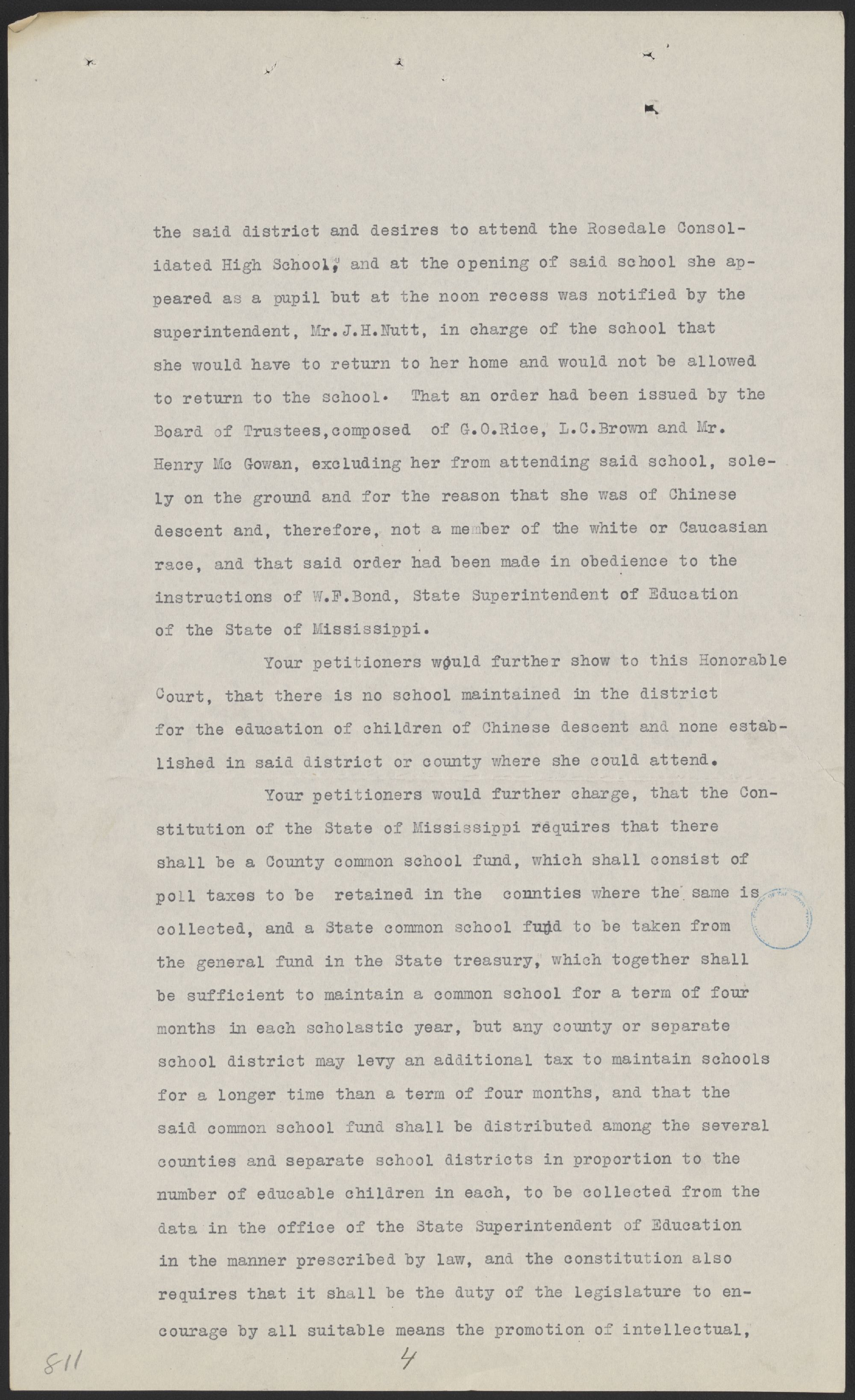
That an order had been issued by the Board of Trustees [...] excluding her from attending said school, solely on the ground and for the reason that she was of Chinese descent
The petition alleged that Martha Lum was excluded from school in Rosedale because of her Chinese descent.
Reading limits
Source-ledger reading; no independent human or community review.
Independent proof of the alleged board order or W. F. Bond instruction.
Transcription
d5e42f5018a9…version legacy
Image
6886d0e6542f…
Source guide
What is being asked for here, and on what grounds?
The petition states that the board of trustees ordered Martha Lum's exclusion, and that the stated reason was her Chinese descent. This is the family's pleading as filed: it is the allegation the court was asked to act on, not an agreed finding of fact.
What would I need in order to say why she was really excluded?
The trustees' own order or minutes. This document preserves what the petition alleged about that order; the order itself is not reproduced here.
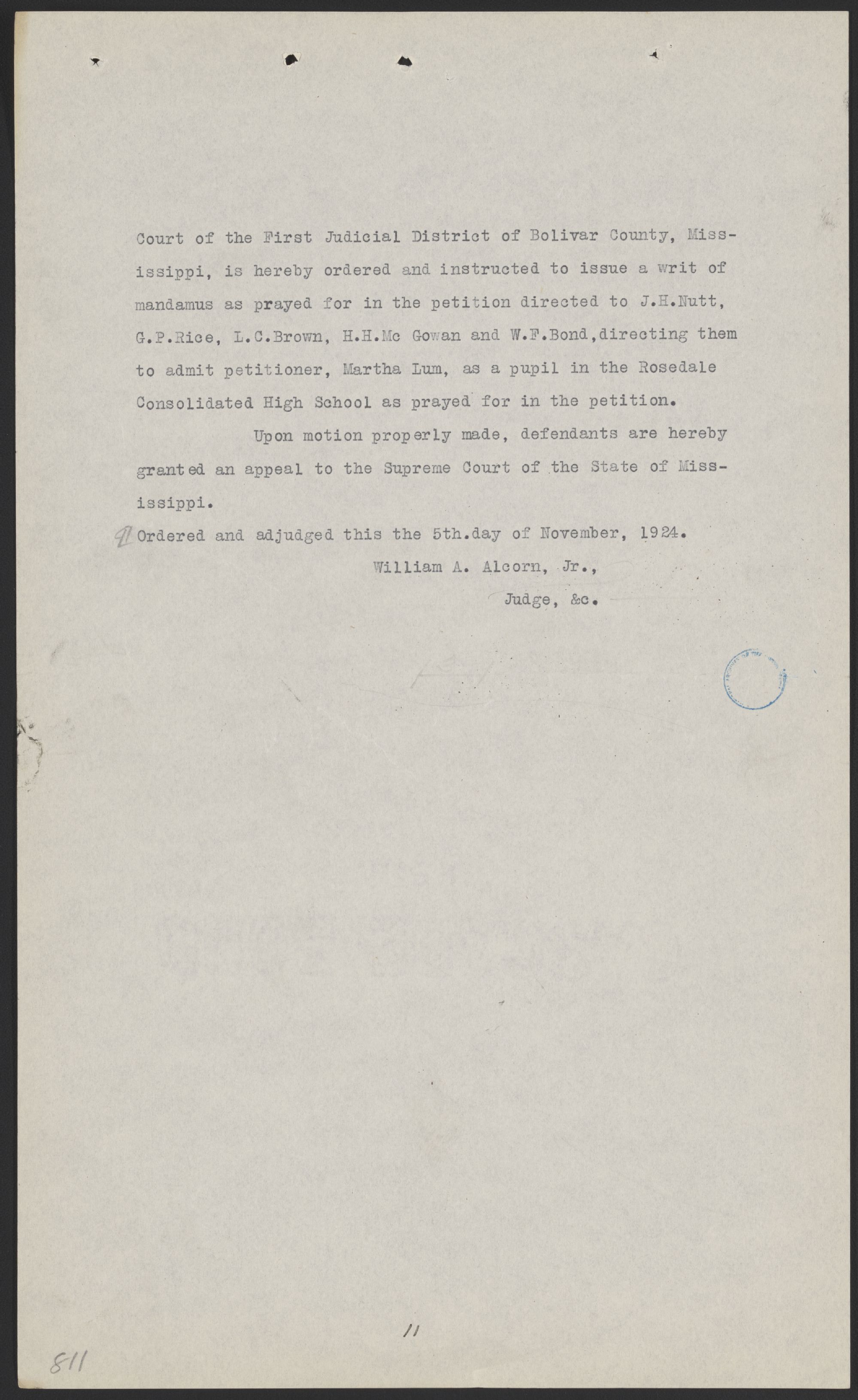
directing them to admit petitioner, Martha Lum, as a pupil in the Rosedale Consolidated High School as prayed for in the petition. Upon motion properly made, defendants are hereby granted an appeal to the Supreme Court of the State of Mississippi.
The circuit court directed a writ admitting Martha Lum and allowed the defendants an appeal. The Mississippi Supreme Court later reversed.
Reading limits
Source-ledger reading; no independent human or community review.
An order directing admission does not establish subsequent attendance. Only page 11 is displayed; the complete two-page record remains linked.
The preceding page is not reproduced. This bounded excerpt is supported on the displayed second page. Line-end hyphenation joined.
Transcription
5c1375511d8f…version page11-v1
Image
c5b599371bf6…
Source guide
Does this order show that Martha Lum attended the school?
No. The court directed the trustees to admit her, and in the same order granted the defendants an appeal. A direction to admit is not a record of attendance, and the appeal means the direction did not stand as the last word.
Why is only one page of this order shown?
Because only that page carries the words quoted. The passage runs across two pages of the transcript, and the preceding page is not reproduced here, so the displayed excerpt is narrowed to what page 11 actually supports. The complete record stays linked.
The Mississippi Supreme Court reverses the admission order
Document excerpt
The legislature is not compelled to provide separate schools for each of the colored races, and, unless and until it does provide such schools and provide for segregation of the other races, such races are entitled to have the benefit of the colored public schools.
Image rights restrict republication. View the original below.
Rice v. Gong Lum, 139 Miss. 760, 104 So. 105 (1925)
The legislature is not compelled to provide separate schools for each of the colored races, and, unless and until it does provide such schools and provide for segregation of the other races, such races are entitled to have the benefit of the colored public schools.
In 1925, the Mississippi Supreme Court placed the Chinese school litigants within the colored public-school system under its reading of state law.
Reading limits
Source-ledger reading; no independent human or community review.
This establishes the court’s ruling, not an independent account of attendance or facilities.
Transcription
94e44a2335cd…version legacy
Image
Not reproduced
Source guide
What did the Mississippi Supreme Court decide?
It reversed the admission order, on the reasoning that the legislature need not provide a separate school for each group classed as colored, and that until it does, such groups may be sent to the colored public schools. The court decided where the state could require her to go; it did not decide that she attended anywhere.
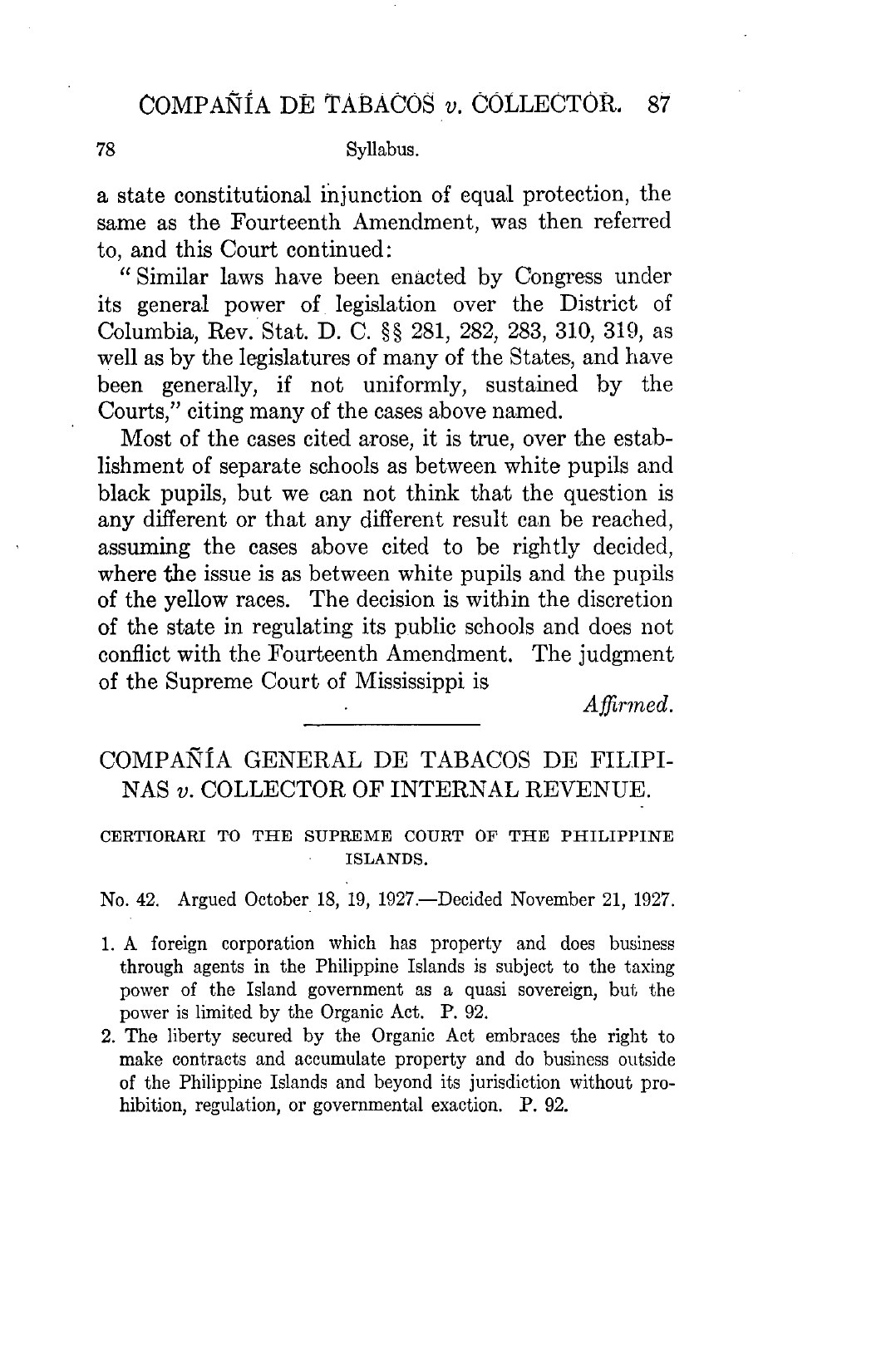
where the issue is as between white pupils and the pupils of the yellow races
Shows the Supreme Court extending segregation doctrine to Chinese pupils.
Reading limits
Source-ledger reading; no independent human or community review.
Independent proof of the alleged board order, facilities, attendance after exclusion, or local implementation outside the pleaded record.
Transcription
2738423af4e8…version legacy
Image
b6dcdd3f7907…
Source guide
What did the United States Supreme Court settle?
It affirmed the state judgment, treating the question as one of classification between white pupils and pupils it called of the yellow races within a school system the Court accepted as separable. It is a decision about the constitutionality of that classification, not a finding about the Lum family's circumstances.
The school-law compilation printed a requirement for separate white and colored schools. The petition sought Martha Lum’s admission; the circuit court directed a writ of mandamus, an order compelling the requested act. The state court reversed, and the federal decision affirmed that judgment. These judicial outcomes do not show subsequent attendance.
Read the school-law sourceNewspaper coverage during the case4 of the 5 acts above fall in years this scan cannot show. The completed pass read 306,555 pages across all 39 Mississippi batches; 23,320 carry one of ten identity words, and not one of those is from 1924, 1925, 1926. That is a fact about what has been digitised into these batches, and about a ten-word filter, not about what the newspapers printed. The case is documented anyway, because court records are not newspapers.
Other accounts of the dispute
The Clarksdale printing reports earlier attendance in Rosedale. It is not an enrollment register.